Skip to content

Financial news + insight

Articles in Dawn

GENERAL

2 in 10 Pakistanis believe country is on right track: Ipsos survey
GeneralJune 3, 2026

2 in 10 Pakistanis believe country is on right track: Ipsos survey

ISLAMABAD: Only two in 10 Pakistanis surveyed believe the country is on the right track, with optimism higher among some groups, a survey conducted by market research company Ipsos shows. Men are more optimistic than women, while rural residents show more optimism than those in urban areas. Of the four provinces, respondents in Khyber Pakhtunkhwa were the most optimistic about Pakistan’s economy. The survey also found that confidence in the country’s direction has fallen to 22pc, following a 40pc peak earlier this year amid US–Iran tensions. The drop indicates a sharp reversal of recent gains, returning to levels broadly comparable with the Covid-19 period. The survey, conducted last month, included interviews with more than 1,000 people from all four provinces of Pakistan, as well as Islamabad, Gilgit-Baltistan and Azad Jammu and Kashmir (AJK). The most pressing issues mentioned in the survey include economic anxiety, unemployment and inflation. When asked about the current state of the economy, only one in five respondents said the economy was strong. Among respondents, men were more optimistic than women, and young people were more optimistic than older people. Furthermore, residents of Khyber Pakhtunkhwa, Sindh and Balochistan were more optimistic than those in Punjab. Respondents identifying as lower-middle-income also showed more optimism than those in other income groups. As many as 7pc of respondents said they feel comfortable making household purchases, with comfort higher among young people, the upper-middle class, urban residents and respondents in Sindh. The level of comfort with household purchases has returned to Covid-era levels after a period of stabilisation amid global economic pressures. The survey shows that only two in 10 respondents expect the economy to strengthen, with optimism concentrated in Khyber Pakhtunkhwa and Balochistan, affluent areas, rural areas and among older respondents. “Expectations for the economy have declined as rising economic pressures drive a gradual return of pessimism. Personal financial optimism has fallen to 31pc amid weaker sentiment and continued sensitivity to geopolitical shocks such as US–Iran tensions,” it stated. It also found that confidence in personal financial situations has fallen to 31pc, with relatively higher optimism among youth, men, rural residents, respondents in Punjab and Balochistan, and upper-income groups. “Confidence in investment remains low at 14pc after a period of stabilisation, with higher optimism among the upper-middle class, respondents in Balochistan and Khyber Pakhtunkhwa, and among men. Comfort in making major purchases remains low at 5pc, stabilising after earlier gains during and after the Pakistan–India conflict,” it said. The findings show that only one in five Pakistanis feel secure in their jobs, with higher confidence among men, young people, mid-career cohorts and rural residents. Job security confidence, which had nearly doubled over the past two years, has now fallen to 17pc amid US–Iran tensions.

Dawn2 min read
Below-normal rainfall, above-normal temperatures expected in most parts of country from June to August: PMD
GeneralJune 3, 2026

Below-normal rainfall, above-normal temperatures expected in most parts of country from June to August: PMD

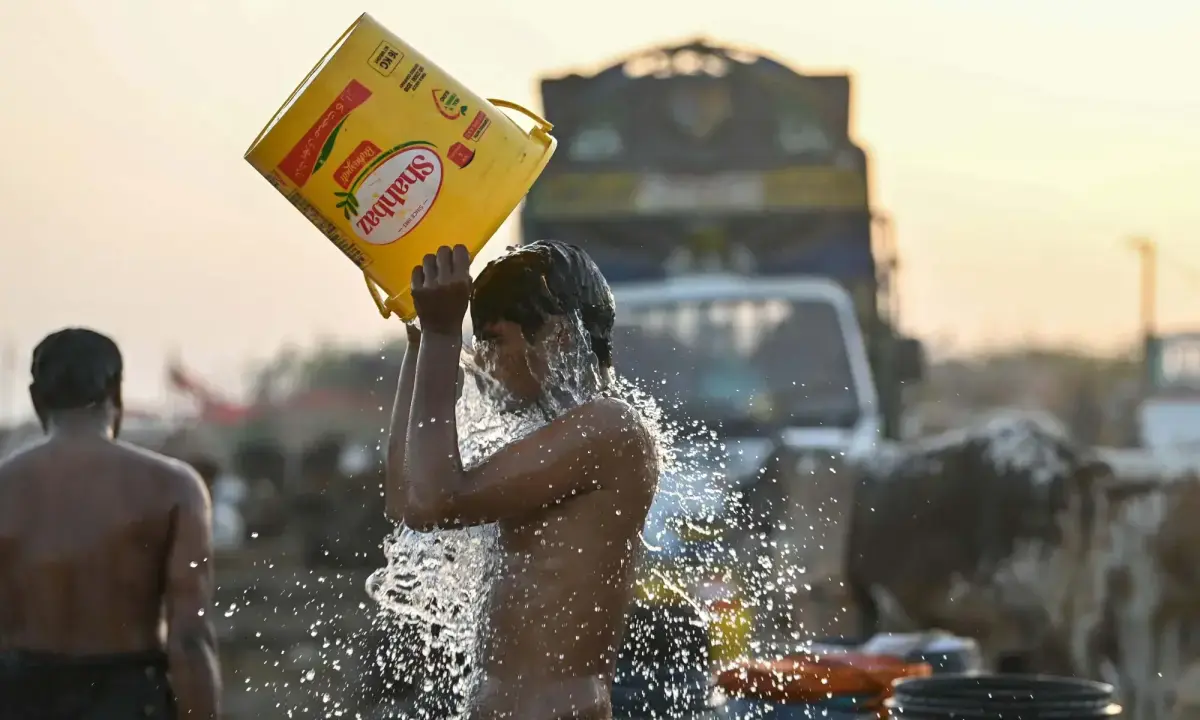
The Pakistan Meteorological Department (PMD) on Wednesday forecast below-normal rainfall and above-normal temperatures across most parts of the country during the months of June to August. The PMD said in its outlook that the Indian Ocean Dipole (IOD) is currently in a neutral phase and is expected to shift to a positive phase by July 2026, while the El Nino–Southern Oscillation (ENSO) has moved into a positive phase (El Nino) and is expected to strengthen further during the season. In view of these conditions, the PMD said that “normal to below-normal” rainfall was expected over most parts of the country during the June–July–August (JJA) season, with the largest negative departures likely over the northeastern parts of Punjab. The findings were reinforced by the Met Office’s probability outlook, which indicated a high probability of below-normal rainfall across most of Pakistan, particularly Punjab, Sindh, southern Khyber Pakhtunkhwa and most of Balochistan. “In contrast, near-normal to slightly above-normal rainfall is anticipated over the northern regions, including Gilgit-Baltistan, adjoining areas of northern KP, and Kashmir,” it added. Comparative maps showing normal versus predicted rainfall in Pakistan. — via PMD Meanwhile, mean temperatures are expected to remain above normal throughout the country during the JJA season, with maximum departure over the northeastern parts of the country — particularly eastern GB, Kashmir and adjoining areas of northern Punjab. The probabilistic temperature outlook indicated the likelihood of “above-normal temperatures across much of the country, with the highest likelihood over Sindh, southeastern Balochistan, and central to northeastern parts of Punjab”. In contrast, western GB is projected to tend towards below-normal temperatures, it added. Comparative maps showing normal versus predicted temperatures in across Pakistan. — via PMD The PMD warned that lower levels of rainfall were likely to cause “moisture stress for Kharif sowing and early crop development, reduced rain-fed agricultural productivity, and increase in irrigation demand”. Excess precipitation in upper catchment areas is likely to improve reservoir water levels, supporting sufficient water availability for agriculture and the power sector, it added. It also highlighted the increased likelihood of flash floods and landslides, particularly in mountainous and flood-prone regions of northern Pakistan, due to the higher levels of rainfall, and warned of urban flooding in low-lying areas of major cities across the four provinces. Meanwhile, high temperatures and humid conditions due to intermittent rainfall episodes, particularly in the southern regions, may increase the risk of vector-borne diseases such as dengue, it said. Indicating a likelihood of heatwave development particularly over the plains of southern Punjab and Sindh, it warned that sharp temperature gradients could cause “strong winds, dust storms, and hailstorms, which may adversely affect crops and infrastructure, reduce visibility, and disrupt transportation”. The PMD also warned that elevated temperatures in GB and Kashmir are expected to enhance snowmelt, potentially increasing glacier-related hazards such as glacial lake outburst floods (GLOFs) and raising river water levels. Timely monitoring and control measures were essential to avoid accelerated pest and disease development in crops, it added.

Dawn2 min read
OGDCL makes significant oil, gas discovery in Sindh’s Sanghar district
GeneralJune 3, 2026

OGDCL makes significant oil, gas discovery in Sindh’s Sanghar district

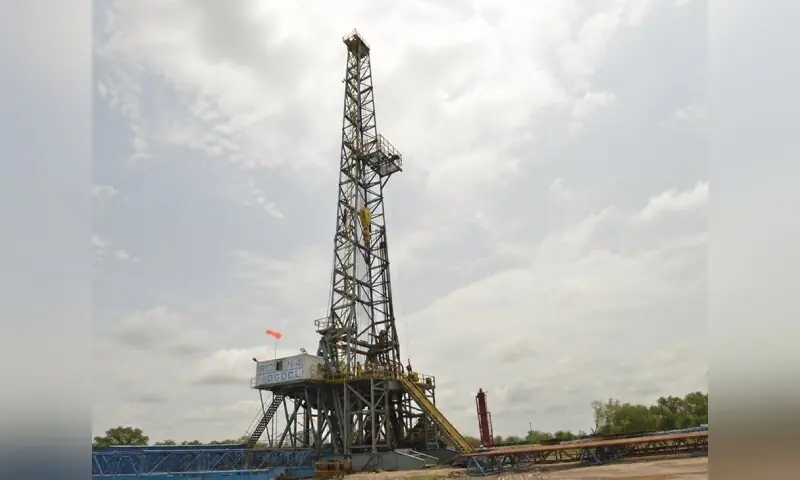
ISLAMABAD: The state-owned Oil and Gas Development Company Limited (OGDCL) on Wednesday said it made a significant oil and gas discovery from its exploratory well Bobi Deep-1, located in Sindh’s Sanghar district. The company is the country’s largest oil and gas producer and, in April this year, began commercial production from Pakistan’s largest-ever oil and gas discovery from a single well. In a statement issued today, OGDCL said the well successfully tested the Massive Sand interval of the Lower Goru Formation and produced 2,000 barrels of oil per day (bpd) and 1.1 million standard cubic feet of gas per day (mmscfd) through a cased-hole Drill Stem Test (DST), confirming the hydrocarbon potential of the reservoir. A Drill Stem Test (DST) is a temporary well-completion procedure used in oil and gas exploration to assess the pressure, permeability and production potential of a geological formation. It helps determine whether a well has encountered a commercially viable reservoir without the need for costly permanent casing. “The achievement marks a major milestone for OGDCL as the first hydrocarbon discovery from the Massive Sand play within the Bobi and Dhamraki Mining Lease,” the company stated. “Beyond the discovery itself, the success has opened a new exploration window in the area, de-risking similar prospects in the surrounding region and creating opportunities for future reserve additions and resource growth,” said the oil company. The discovery is particularly significant because the project had previously encountered complex subsurface challenges that led to the suspension of drilling operations. “Rather than abandoning the prospect, OGDCL relied on indigenous expertise and adopted an innovative approach to address the issue,” it said. A multidisciplinary team of geoscientists and engineers collaborated with the Centre for Pure and Applied Geology at the University of Sindh, Jamshoro, to investigate the formation through advanced geophysical surveys, subsurface studies and field evaluations. The joint effort led to the development of a comprehensive geological and geophysical model, enabling OGDC to de-risk the prospect and resume operations. Multiple engineering safeguards, specialised civil works and extensive technical evaluations were carried out before the drilling rig was redeployed and the target depth successfully reached. “The exploratory well Bobi Deep-1 success story stands as a testament to indigenous innovation, technical excellence and industry-academia collaboration. It demonstrates how local expertise can successfully resolve complex operational challenges and unlock new hydrocarbon resources for the country,” the company said. “The discovery is expected to contribute towards enhancing Pakistan’s indigenous oil and gas production, strengthening national energy security, reducing reliance on imported energy and augmenting the hydrocarbon reserves base of the country,” it concluded. Last April, OGDCL announced the successful revival of oil and gas production from Chak#2-2 well, a joint venture in the Sinjhoro Block in Sanghar. The Sinjhoro Block comprises OGDCL as the operator with a 62.5 per cent working interest, alongside Government Holdings (Pvt) Ltd (GHPL) with 22.5pc, and Orient Petroleum Inc. (OPI) holding a 15pc share.

Dawn2 min read
Bilawal pledges to address Diamer-Bhasha Dam resettlement issues if PPP wins G-B polls
GeneralJune 3, 2026

Bilawal pledges to address Diamer-Bhasha Dam resettlement issues if PPP wins G-B polls

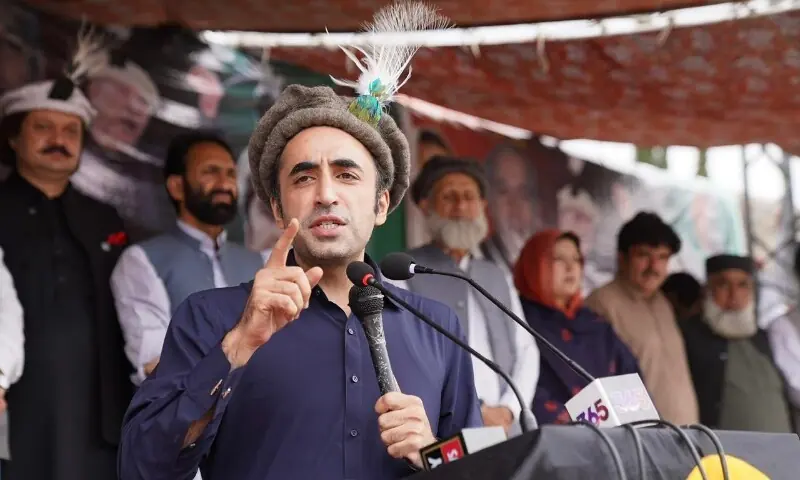
PPP Chairman Bilawal Bhutto-Zardari on Wednesday vowed to address resettlement concerns of those affected by the construction of the Diamer-Bhasha Dam on an “immediate basis” if his party emerges victorious in the June 7 polls. Bilawal made the declaration while addressing a rally in Diamer, as the PPP and other political parties have, over the past few days, ramped up efforts to garner support ahead of the polls. Addressing the rally, the Bhutto scion asserted that the project saw “great progress” during the PPP’s tenure. He added that had President Asif Ali Zardari’s government not been removed in 2013, the Diamer-Bhasha Dam would have been built by now. The PPP chairman lamented that it was “unfortunate” that affected citizens of the region had not had their resettlement issues addressed. “I would like to promise you that after June 7 — when PPP forms government in GB — we will ensure that the work is [completed] and as far as resettlement is concerned, we will address it on an immediate basis,” Bilawal said. He urged the Centre to prioritise the construction of the dam. “This is not only the right of the people of Diamer, but it is a necessity for Pakistan,” the PPP chairman said. “No project is more important for Pakistan at the moment than the Diamer-Bhasha Dam,” Bilawal emphasised, calling on Prime Minister Shehbaz Sharif to expedite work on the project. “We have heard of your ‘Shehbaz speed’ in Lahore [..] please show your ‘Shehbaz speed’ to the people of Diamer as well and ensure that the project is completed,” Bilawal quipped. In April, the Diamer-Bhasha Dam land-affected committee, under the ‘Huqooq Do, Dam Banao’ (ensure rights, build the dam) movement, staged a sit-in in the Chilas and Thore areas of Diamer that lasted several days, over the non-implementation of a 2025 agreement on compensation for those affected by the construction of the dam, among other demands. Bilawal calls on GB to elect jiyala CM Bilawal claimed that PPP was the “sole political party which was looking out for the interest of the people of GB and had the people’s faith”. “On June 7, the people of GB will demonstrate their power and elect a jiyala chief minister,” Bilawal said. Outlining PPP’s contributions towards the region, Bilawal recalled that it was his father, President Zardari, who “gave GB its current identity as the region was referred to as Northern Areas before”. Taking note of the regional crisis, Bilawal stressed that Pakistan needed a government “like PPP who can look the world in the eye”, adding that they were only able to do so as the party was the “true representative of the Pakistani people”. He called on the people of GB to “struggle against these difficult times and ensure the formation of a PPP government in the region”. At this, Bilawal also voiced optimism that the country will see similar results in the next general elections. The PPP chairman reiterated his support for “securing GB’s constitutional rights,” stressing that Islamabad must understand that “Pakistan can only prosper if the people of GB prosper”. He vowed that with the party’s public-private partnership initiatives, “not only will you fulfil your own energy requirements but also sell it to the rest of the country”. “I am not here to air any grievances; it is not in our nature. Why was the Quaid-i-Awam (former prime minister Zulfiqar Ali Bhutto) hanged or why my mother (former prime minister Benazir Bhutto) was martyred [..] have you ever heard me complain? or why was my father was imprisoned for 14 years [..] we are not the kind to complain; we only know how to take back our rights. So support me, and I will not disappoint you,” Bilawal told the rally. The PPP chairman also took a jibe at the ruling ally PML-N, wondering why the “rest of the political parties campaigning in GB looked so worried”. “Throwing money at things might work in Lahore, but not in GB; the people here are honourable and cannot be bought,” he quipped. “Many political parties make claims that they have carried out considerable development work in their provinces; I would like to tell you that whatever you have been able to do was because of President Zardari”. He recalled that President Zardari was responsible for the 18th Amendment, which enabled greater provincial development. “If they were able to build metros or run trains in any city, it was because of the 18th Amendment and the NFC Award, which enabled provinces to secure the resources needed for such development projects,” Bilawal said. First Lady Aseefa Bhutto-Zardari also addressed an election rally in the region, calling on people to support the PPP and stressing that the party’s electoral symbol, the arrow, was “a symbol of rights, betterment, power and hope for the poor, and the identity of democracy”. Expressing support for her brother’s vision, Aseefa said a PPP-led government would create opportunities for the youth, including quality educational institutions, IT parks, improved internet connectivity and employment. “We want every youth of GB to see a bright future, for everyone to have access to healthcare, and for every child to be educated,” she said.

Dawn4 min read
If you need to use the loo on the way to Turbat
GeneralJune 3, 2026

If you need to use the loo on the way to Turbat

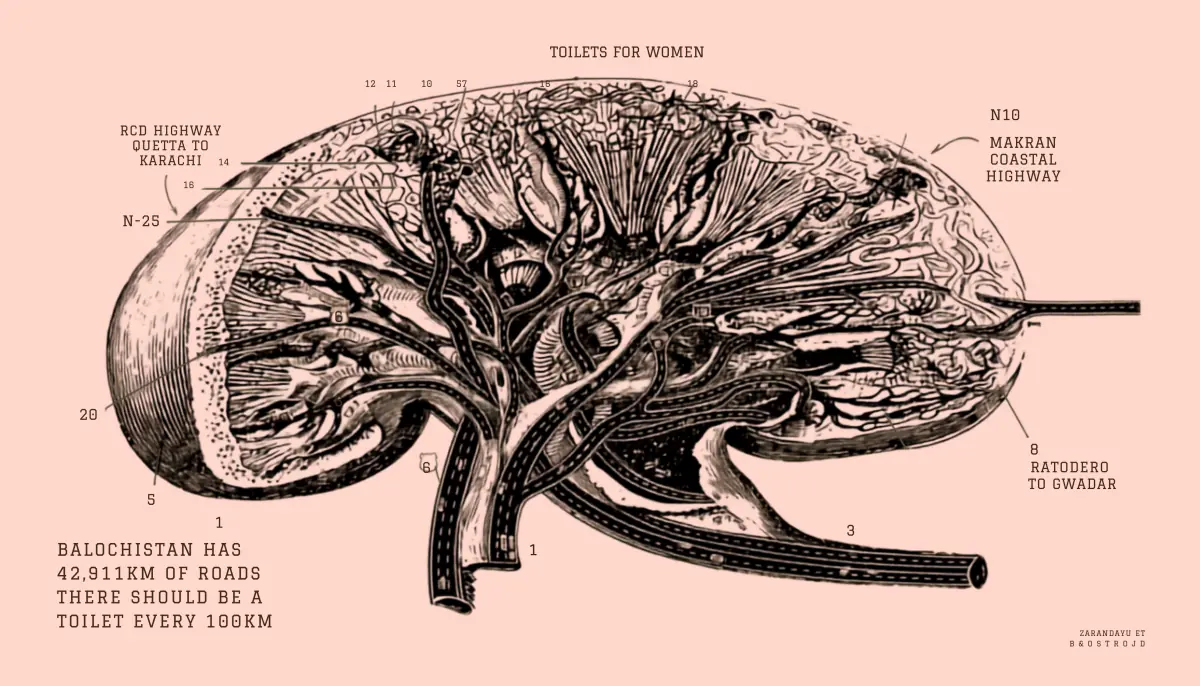
The bus lurched to a halt on the long, dry highway that takes you from Gwadar to Turbat. A clutch of men jumped out and sprinted towards the makeshift bathroom by the road. Some of them scattered into the bushes. Back in the bus, anchored to their seats, women stared out of the windows stiffly. They must have done the math before boarding: drink enough water to bear the heat, but not so much that you need to empty your bladder. Gwadar to Turbat is a short two hours. But it is eight long ones if you are heading to Karachi. A washroom on the Makran Coastal Highway between Turbat and Gwadar Balochistan’s new and smooth highways are praised as corridors of connectivity and trade and promise progress for a place that has long been politically and geographically distant from the rest of Pakistan. Motorway 8 goes from Ratodero to Gwadar, the N-10 runs along the Makran coast, the N-25 RCD Highway connects Quetta to Karachi and the N-40 that meanders towards the Iran border from Quetta to Taftan. But the praise for this network does not make up for the lack of safe and accessible public bathrooms for hundreds of kilometers. Where you do find one, it is rudimentary at best, a hole in the ground, a door that won’t close or lock and almost never any running water. To make matters worse, the women’s toilets are usually located in male-dominated spaces, such as roadside motels, dhabas, and bus stops. In Surab, washrooms are attached to the mosques and are strictly off limits for women. This neglect is now being challenged in court by Kulsoom Baloch, Fauzia Shaheen and Dr Quratulain Bakhtiari. They filed a complaint in the Balochistan High Court, arguing that the highways are deliberately designed to prioritise the cold mechanics of commerce at the expense of human safety, accessibility and equity. They said that the long stretch between Mastung and Kalat is the worst affected. There isn’t a single restroom for women when you travel from Quetta to Makran through Kalat and Mastung. The Karachi to Quetta-Chaman N-25 Highway is being widened into a double carriageway but toilets for women are missing from the plan. The government has to provide sanitation which is a constitutional right as Article 9 guarantees the right to life and dignity, 14 protects the dignity of the people and privacy at home, and 15 ensures the right to movement. “Men are socially free,” says Kulsoom. “They can go anywhere for nature’s call. Women are restricted socially and culturally, and their biological needs are different.” Unusable washrooms in Ormara and Gwadar Fatima, 46, describes one of her experiences. She was travelling from Turbat to Karachi for eye surgery with her husband and daughter. The bus had been on the road for a couple of hours until it stopped near a roadside hotel in Ormara. Ormara, located in Gwadar along the Makran Coastal Highway, is often the first and only major stop for buses travelling from Turbat and Gwadar to Karachi. During this journey, the first stop is usually this deserted hotel in Ormara, where bus drivers and conductors often receive free meals in exchange for bringing passengers. There were four bathrooms, supposedly for men and women both, and all of them were broken, dirty, and without door locks. She entered the dingy bathroom but her eyes kept darting towards the ajar door. Her daughter came to the rescue. “She held the door while I was inside … we had no other choice,” she says. “There’s a lingering fear that men nearby can see you. It feels humiliating.” At Gwadar’s Zero Point, which is about 90km from Hub town, there are two bathrooms, but both are unusable. “When the vehicle stops for security checks,” says Kulsoom, “women looking to use a bathroom are told to, ‘go as far as you can’.” The story is the same from Yousuf Goth Terminal in Karachi, used by passengers from Balochistan daily, to Khuzdar’s Chamrock Hotel and Restaurant (another bus stop). Dozens of women line up inside warehouses, waiting their turn to use the few available toilets. Women who regularly need to travel fall sick with urinary tract infections, diarrhoea and dehydration. Urologists warn that holding urine for hours on end causes bladder infections and serious kidney problems. In many parts blanket bans on night-time public transport are imposed when there is a threat of violence. Protests, road blockades, security checks and insurgent raids often leave women stranded for hours, if not days. A student, Saadia, was stuck on the M-8 Motorway for two days last year. “We did not have proper food, water or basic facilities. At one point, we walked several kilometres to a nearby bazaar just to use a bathroom,” she says. The only washroom at the Talaar Checkpost with proper signage and running water Saif owns a hotel on the Makran Coastal Highway at Ormara. He handles 15 to 20 buses daily with each bus carrying roughly 400 passengers. This means up to 800 travellers use his 19 bathrooms every single day. “Business is very weak these days, and on top of that, there is a major water issue,” he says. A broken sewerage system and chronic power failures cripple his efforts to maintain hygiene. He tried introducing a Rs10 upkeep fee to pay a dedicated cleaner but most passengers cannot afford to pay even this amount. He appealed to the transport companies to subsidise the maintenance cost as their passengers benefit from the stopovers without contributing towards sanitation. “The buses only stop for meals and then leave. We have spoken to bus operators time and again but they don’t cooperate,“ he says. It would cost around Rs300,000 to Rs400,000 to build good quality bathrooms. The local authorities hardly help small business owners like Saif who they fine instead of assisting with infrastructure grants or water tankers. “The Assistant Commissioner came once and fined me without any prior warning,” says Saif. He ordered him to build a chabutra (a raised platform) in the bathrooms but didn’t offer any financial support. The Balochistan Development Statistics report of 2018-2019 says the province has 42,911 kilometres of roads, with national and provincial highways connecting districts and towns. International highway design guidelines say that key rest areas should be constructed every 80km to 100km, with smaller stop points at every 50km. Washrooms along the route from Quetta to Makran If such designs were applied, the 653km Makran Coastal Highway for instance, would need at least seven rest stops. The 892km M-8 would need eight and the 487km N-85 Surab-Panjgur-Hoshab highway would need five. To pull this off, safe gender-segregated resting areas should be built in towns along these routes such as Awaran, Turbat, Gwadar, Chaghi, Pasni, and Ormara. In more isolated stretches, eco-friendly and water-efficient technologies could be viable alternatives to provide these spaces lighting, clear signage and proper maintenance systems. And infrastructure is only as good as the insight behind it. If women are not included in the designing, the facilities will fall short of their needs. As Kulsoom Baloch says, “True development begins with the basics. In Balochistan, it is always the opposite. Roads are constructed first, celebrated as progress.” No one even thinks of toilets.

Dawn6 min read
Israel plans major expansion of West Bank settlements on occupied Palestinian land
GeneralJune 3, 2026

Israel plans major expansion of West Bank settlements on occupied Palestinian land

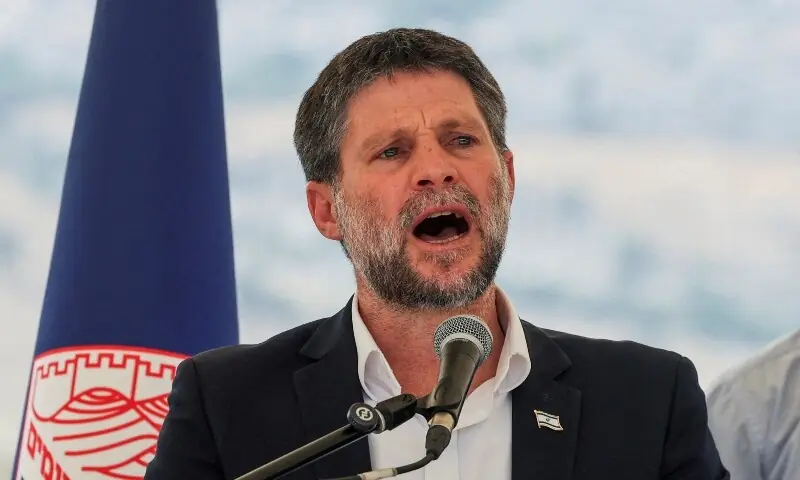
Israel’s hardline finance minister announced on Wednesday a major expansion by more than 2,000 homes of three Jewish settlements in the occupied West Bank that Palestinians hope will be part of a future independent state. Most nations consider Israeli settlements there to be illegal under international law and a major obstacle to a two-state solution for long-term peace. Bezalel Smotrich, who holds authority over parts of Israel’s civilian administration in the West Bank, said a planning committee approved the construction of 2,162 new Jewish homes. They include 1,006 units in a new settlement near Jerusalem, 922 near the Palestinian city of Nablus and 234 near Hebron. “We are continuing to build the Land of Israel in practice,” said Smotrich, an ultra-nationalist sanctioned by Britain, France and others who accuse him of inciting violence against Palestinians. Smotrich has denounced the sanctions against him, saying the measures would not change Israeli policy. The new homes would “strengthen our hold on the land, reinforce Israel’s security, and establish clear facts on the ground that prevent the creation of an Arab terror state in the heart of the country,” Smotrich said in a statement, without specifying when construction would begin. Since becoming a minister three years ago, Smotrich has sought to tighten Israel’s control and presence in the West Bank while advocating against the idea of a Palestinian state. Prime Minister Benjamin Netanyahu’s right-wing government has overseen the significant expansion of Jewish settlements in the West Bank and the establishment of new settlements. Independence aspirations Palestinians want the West Bank as part of a future independent state that includes East Jerusalem and Gaza. Around half a million Israelis live in the West Bank among about three million Palestinians. US President Donald Trump’s administration has been far less critical of the fast-expanding Israeli settlements. However, Trump did say last September that he would not allow Israel to annex the West Bank, angering some right-wing Israeli lawmakers. The United Arab Emirates, one of the few Arab states to have official ties with Israel, has also publicly warned the Israeli government against annexation. Condemning Wednesday’s announcement, Palestinian President Mahmoud Abbas’ office warned that Israel’s “provocative” policies were pushing the region towards more rounds of violence and called on the US to stop the Israeli “madness”. Smotrich on May 19 said he would wage “war” on the Palestinian Authority, which exercises limited civic rule in the West Bank, after he said he was told the International Criminal Court (ICC) prosecutor had sought a confidential arrest warrant against him. The ICC has not confirmed that.

Dawn2 min read
GB local government elections scheduled for Aug 2, CEC says
GeneralJune 3, 2026

GB local government elections scheduled for Aug 2, CEC says

Gilgit-Baltistan’s Chief Election Commissioner (CEC) Raja Shahbaz Khan announced on Wednesday that the region’s long-delayed local government (LG) elections have been scheduled to be held on August 2. General elections for the region’s legislative assembly were scheduled for Jan 24, 2026, while LG polls — announced after a gap of more than 20 years — were set for Feb 14, 2026. However, days after the announcements, both were postponed indefinitely due to harsh weather conditions in the region. Earlier this month, Khan said the GB Election Commission was preparing to hold the elections but had not yet set a date. In a press conference today, the CEC said that the schedule for GB’s local body polls had been issued, and returning officers (ROs), district returning officers (DROs) and assistant returning officers (AROs) had been appointed. He said a public notice would be issued by the returning officers (ROs) on June 6, while nomination papers would be accepted from June 9 to 15. The elections would be held for union councils, district councils, town committees, municipal committees and municipal corporations. The remaining process was listed in the full schedule, Khan said, adding that the last local body election had taken place in 2004, 22 years ago. “Delimitation and demarcation have been completed under the Local Government Act of 2014,” he said further. Khan further stated that there had previously been two systems in GB: a local district council and a union council, with municipal committees in urban areas. In place of this, he said, now there would be town committees, municipal committees and municipal corporations in urban areas. Earlier, political parties in the region were uncertain about holding elections before June but feared that they could be delayed until October. They agreed that holding elections during Muharram, which begins on June 15 or 16 this year, or on other religious occasions such as Chehlum, was not possible. Political leaders, therefore, feared that postponing elections beyond June could effectively delay them until September or October.

Dawn2 min read
'I was a little bit perturbed': Trump confirms expletive-laden phone call with Netanyahu
GeneralJune 3, 2026

'I was a little bit perturbed': Trump confirms expletive-laden phone call with Netanyahu

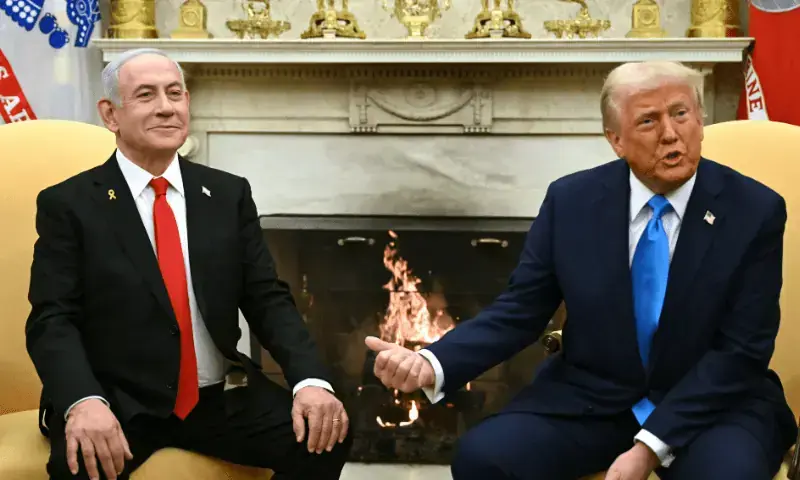
US President Donald Trump has confirmed that he had lashed out at Israeli Prime Minister Benjamin Netanyahu over the latter’s escalation in Lebanon in a recent expletive-laden phone call. On Monday, American news outlet Axios reported citing sources that Trump called Netanyahu “crazy” and accused him of ingratitude during the phone call. The report quoted a US official as saying that Trump told Netanyahu “you’re f****** crazy. You’d be in prison if it weren’t for me. I’m saving your a**. Everybody hates you now. Everybody hates Israel because of this”. Trump confirmed to New York Post’s Miranda Devine during ‘Pod One Force’ podcast that he called Netanyahu “f****** crazy”, but also insisted that they have “worked very well together”. Asked if the Axios report was true and whether he spoke to Netanyahu in those terms, Trump replied, “I did. I wouldn’t say angry, I was a little bit perturbed at his constantly fighting with Lebanon. “At some point, I said Bibi, we’re gonna stop this. We got to stop it,” he added. At the same time, Trump said, “But I have a very good relationship. […] We’ve worked very well together. I like Bibi a lot. And I work very well with him,” Trump insisted after confirming his expletive-laden outburst demanding that Netanyahu cease attacks. “I’m a wartime president,” the commander-in-chief said. “He’s a wartime prime minister.” @dawn.today US President Donald Trump has confirmed that he had lashed out at Israeli Prime Minister Benjamin Netanyahu over the latter’s escalation in Lebanon in a recent expletive-laden phone call. On Monday, American news outlet Axios reported citing sources that Trump called Netanyahu “crazy” and accused him of ingratitude during the phone call. The report quoted a US official as saying that Trump told Netanyahu “you’re f****** crazy. You’d be in prison if it weren’t for me. I’m saving your a**. Everybody hates you now. Everybody hates Israel because of this”. Asked if the Axios report was true and whether he spoke to Netanyahu in those terms, Trump replied, “I did. I wouldn’t say angry, I was a little bit perturbed at his constantly fighting with Lebanon. “At some point, I said Bibi, we’re gonna stop this. We got to stop it,” he added. DawnToday ♬ original sound - Dawn.com - Dawn.com Israeli officials have not commented publicly on the phone conversation since the Axios report, but Israeli media have quoted sources playing down the friction between the two leaders. Trump further said that although he was frustrated by the possibility of Lebanon-Israel conflict derailing a larger peace, he remained optimistic about having a deal with Iran “fairly quickly”. At one point during his interview, Trump was also asked about people saying Netanyahu “tricked” him into the Iran war. Criticising the Democrats for such remarks and their policy stances, Trump said, “I’m the one that started it […] because we can’t let them have a nuclear weapon. “Now, that pertains to Israel because they probably would have been the first ones to get hit […] I’ll tell you what, if it wasn’t for me, there would be no Israel right now,” he added, recalling his move to terminate the 2015 Iran nuclear deal. @dawn.today US President Donald Trump has rejected suggestions that Israeli Prime Minister Benjamin Netanyahu manipulated him into launching the war on Iran, saying the decision was entirely his own, according to Al Jazeera. “He tricked me? I’m the one that started it,” Trump says on ‘Pod Force One’, adding that he acted because “we can’t let them (Iran) have a nuclear weapon”. Trump attributes the claims to political opponents. “They’re just the Dumbocrats. These are people that don’t know what they’re doing,” he says. The US president adds that his concern over Iran’s nuclear programme dates back to his first term, when he withdrew from the 2015 nuclear deal negotiated under the administration of President Barack Obama. “That pertains to Israel because they probably would have been the first one to get hit. I’ll tell you what, if it wasn’t for me, there would be no Israel right now.” DawnToday ♬ original sound - Dawn.com - Dawn.com The US-Iran conflict is currently stalemated in a shaky ceasefire more than three months after initial US and Israeli strikes on Iran. The delicate diplomatic process keeping hopes for peace between Iran and the US seemed to teeter on Monday after Tehran and Washington offered diverging assessments of the status of negotiations, with Israel’s expanding front in Lebanon proving to be the main spoiler. After Netanyahu ordered attacks on Beirut on Monday, Tehran said it considered the ceasefire violated “on all fronts” and accused the US of violating the truce. Iran also said it had suspended indirect negotiations with the US. The announcement was initially shrugged off by Trump, but he later moved to allay Iranian concerns over Israeli attacks in Lebanon. Not only did he speak to his ally Netanyahu, but he also claimed to have exchanged views with Hezbollah through intermediaries — a first for a US president — to stop the fighting. “There will be no troops going to Beirut, and any troops that are on their way have already been turned back”, he posted on Truth Social, adding that Hezbollah had also agreed to stop attacking Israel. Iran situation ‘rapidly evolving’ During his interview with The Post, Trump voiced optimism regarding talks with Iran, saying that they were “rapidly evolving”. He also insisted that Iran had agreed not to have a nuclear weapon and “lots of other good things are going to happen”. Since mid-March, Trump has repeatedly said he is close to a deal to end the fighting and allow negotiators to tackle thorny issues, including the future of Iran’s nuclear programme. Trump has said his top priority is to stop Iran from acquiring nuclear weapons. Iran denies it is developing a nuclear bomb and says its atomic programme is for peaceful purposes. Trump also said during the interview that Iran’s Supreme Leader Ayatollah Mojtaba Khamenei was “involved, absolutely” in decisions to end the war. “I’d like to meet him,” he said, adding that the two would “probably meet at some point, depending on how it all works out”. He reiterated his claims of destroying Iran’s military, saying, “Their navy’s wiped out. Their air force is all gone after three days. Their military was virtually wiped out.” Trump remarked, “Now we have to make a determination — do we sign a deal or we do it the other way. And the other way is not nice.” However, he added, “But I’d rather do it the nice way from a humanitarian standpoint.” Asked about whether his “other way” would involve only bombing Iran, Trump replied, “Yeah, you don’t have to. We don’t need boots on the ground.” Moreover, the US president asserted that gas prices in the United States would come down when the Iran conflict ends and that inflation at the moment is not “very much”. “We don’t have very much inflation. Look, if you take away just the price of gasoline, the energy, we have very little inflation,” Trump said.

Dawn5 min read
PM Shehbaz stresses need to follow up on recent MoUs during meeting with Chinese envoy
GeneralJune 3, 2026

PM Shehbaz stresses need to follow up on recent MoUs during meeting with Chinese envoy

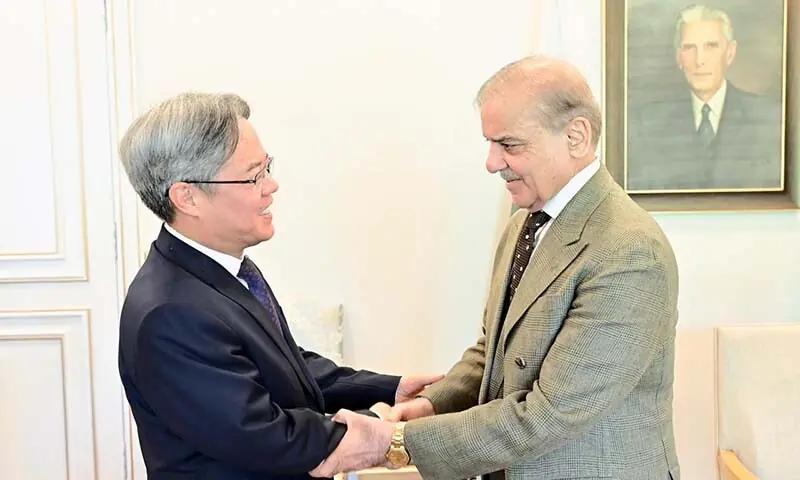
Prime Minister Shehbaz Sharif, during a meeting with the Chinese ambassador on Wednesday, stressed the need to follow up on memoranda of understanding (MoUs) signed during a recent visit to China, the Prime Minister’s Office (PMO) said in a statement. On May 24 in Hangzhou, the premier chaired the opening ceremony of the third Pakistan-China Business-to-Business (B2B) Investment Conference, which was focused on “charging infrastructure, battery energy storage and solar technologies, and pharmaceuticals”. Agreements and MoUs worth more than $7 billion were signed between the two sides at the conference to promote cooperation and investment in various sectors. The PMO, in the statement, said Chinese Ambassador Jiang Zaidong called on the premier at PM House and congratulated him on Eidul Azha, with PM Shehbaz expressing gratitude for his “efforts to make the visit successful, in every aspect”. “While conveying his firm resolve to ensure the further strengthening of Pakistan-China All Weather Strategic Cooperative Partnership, the Prime Minister emphasised the need to immediately initiate necessary actions for follow-up on the important decisions taken during his visit to China,” the statement read. “He particularly stressed upon the need to expand cooperation in key areas under CPEC 2.0, particularly agriculture, IT, industries, including SEZs, and mines and minerals.” PM Shehbaz additionally noted that it was now on both sides to work together and deliver on decisions taken by the leaders of both countries. The PMO further stated that the fast-tracking of the KKH (Karakoram Highway) realignment project, the expansion of security, counter-terrorism and defence cooperation, as well as economic and financial support, were among the topics discussed during the meeting. Pakistan and China have maintained ‘ironclad’ diplomatic relations and a longstanding strategic partnership with ties ranging across different sectors — including trade, energy, defence, and infrastructure. This year marks the 75th anniversary of the establishment of diplomatic relations between the two countries, with events commemorating the occasion held in both countries. During his visit to China, PM Shehbaz hailed 75 years of “glorious partnership” in diplomatic relations, stating, “The credit goes to our founding fathers who worked very hard to build this relationship over the last more than seven decades.”

Dawn2 min read
In meeting with business leaders, PM Shehbaz says govt taking measures to bring informal economy into tax net
GeneralJune 3, 2026

In meeting with business leaders, PM Shehbaz says govt taking measures to bring informal economy into tax net

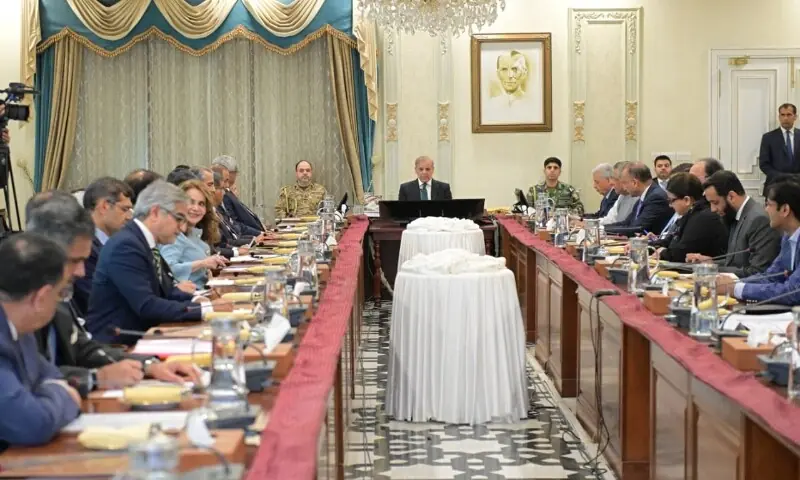
Prime Minister Shehbaz Sharif on Wednesday said that the government was taking measures to bring the informal economy into the tax net in the upcoming budget, the Prime Minister’s Office (PMO) said. The premier made the declaration during a meeting with a delegation of renowned businessmen and industrialists, where he exchanged views with them on the pace of the country’s economic growth and consulted with them over the upcoming budget. “You are the ambassadors of Pakistan,” the premier told the delegation, expressing gratitude for the business community’s support to the government in “difficult economic conditions”. PM Shehbaz noted that a “strong partnership” with the private sector was a “guarantee of economic growth”, and underscored the “utmost importance” of consulting with them over policymaking for the economy. “We are on the path of export-led growth,” the premier remarked, adding that export-led growth was “core” of Pakistan’s economic policy. He told the businessmen that the government was taking actions to bring the informal economy into the tax net, as well as measures aimed at providing relief to the public in the upcoming budget. He noted that the government’s business-friendly policies have made the economy stable and restored foreign investor confidence. PM Shehbaz further outlined plans to promote industries that “increase domestic production, boost exports, and create maximum job opportunities”. “Development in industry, agriculture, and information technology will further stabilise the economy and create new employment opportunities,” the prime minister was quoted as saying. He added that the government had also launched programmes for “technical and vocational training” of the youth to promote employment opportunities. During the meeting, the delegation was “briefed on government’s measures to promote business, industry and trade,” the PMO said. They were informed that reforms were being brought to “tax tribunals for expeditation of tax cases”. “Recruitments in these tribunals have been made through an extremely transparent process,” the delegation was told. They were also briefed that a committee has been formed for the “establishment of special commercial courts”. The delegation was also told that work was underway on the “upgradation of M-10 Motorway and paperless freight corridor to improve inland access from Karachi’s ports”. The business community was further informed that the construction of M-13 Motorway (Kharain-Rawalpindi) will minimise the travel distance between Lahore and Islamabad. As per the statement, the delegation was also briefed on the upgradation of ML-1 and ML-2 railway projects. On artificial intelligence (AI), they were informed that a “National AI Transformation Plan” was being developed. During the meeting, the delegation was briefed that “the installation of video analytics in the sugar and cement sector” had improved revenue collection. According to the handout, the business delegation lauded the prime minister and his team for their diplomatic efforts “to restore peace in the region” — an apparent reference to Pakistan’s role in mediating between the United States and Iran amid the conflict in the Middle East. As per the statement, the leaders expressed faith in Pakistan’s economic recovery and fiscal management under PM Shehbaz’s leadership and thanked him for “setting the economy on the right path and providing the business sector a conducive environment”. The delegation also appreciated the “vision to promote digital payments and a documented economy”. Business leaders also expressed support for measures aimed at “tax reforms and ease of business operations”. “Business leaders expressed gratitude to the prime minister for reducing electricity tariffs for industries, abolishing the export development levy, and ensuring timely payment of tax refunds,” as per the PMO. The move to take the business community into confidence over the upcoming budget was appreciated during the meeting, it said. “Business leaders presented their recommendations to the prime minister on strengthening the economy and on the budget, offering “full cooperation” to the government on economic development. “Participants in the delegation appreciated the government’s commitment to industrial development, increasing exports, and creating new employment opportunities,” PMO added. The delegation included notable businessmen, including Arif Habib, Atif Bajwa, Zeelaf Munir, Muhammad Ali Tabba, Musadaq Zulqarnain, Mian Muhammad Mansha, and Ziad Bashir, among others. Federal ministers Rana Tanveer Hussain, Azam Nazeer Tarar, Musadik Malik, Ahad Khan Cheema, Attaullah Tarar, Shaza Fatima Khawaja, Ali Pervaiz Malik and Awais Leghari were also present.

Dawn3 min read